
Peace of Mind Package
Caregiver Clarity, Organization & Preparedness
$250 | Up to 7½ Hours
When you don’t know where to start, we’ll start together.
When everything feels urgent, it can be difficult to determine what truly needs attention first. You may have paperwork in several places, unanswered questions, phone calls to make, resources to investigate, and family members asking what happens next.
The Peace of Mind Package gives you up to 7½ hours of focused, personalized support to sort through the confusion, identify your priorities, and create a clearer way forward.
Your time can be used to:
- Understand and prioritize: Talk through what is happening now, what is weighing on you, and what needs attention first.
- Organize and clarify: Bring order to caregiving paperwork, contact information, calendars, records, and important documents.
- Research and navigate: Identify community programs, services, facilities, and other resources that may fit your family’s situation.
- Prepare and plan: Organize questions and information for appointments, family meetings, or conversations with care professionals.
- Educate and support: Receive personalized caregiver and dementia education, practical tools, and strategies.
- Complete calls and follow-up: Prepare for or complete agreed-upon communication with agencies, facilities, providers, insurance companies, and community resources when appropriate and authorized.
- Create your next-step roadmap: Leave with a clearer understanding of what has been completed, what still needs attention, and what your family can do next.
Your package time may include meetings, phone calls, research, organization, documentation, and agreed-upon follow-up based on your family’s priorities.
Why Peace of Mind is the better value
Peace of Mind is offered as a reserved package of focused support rather than separate, stop-and-start hourly requests. A larger block of time allows us to spend less time repeatedly revisiting the background and more time working through the concerns in front of you.
You are not paying for less care. You are receiving more focused time, fewer interruptions, and a clearer path forward.
This package is especially helpful when you know you need support in several areas and want enough time to look at the bigger picture.
Christina’s Compassionate Care provides nonmedical coordination, education, organization, and resource support. Services do not include medical, nursing, legal, financial, insurance, or emergency services.
From overwhelmed to a clear way forward.
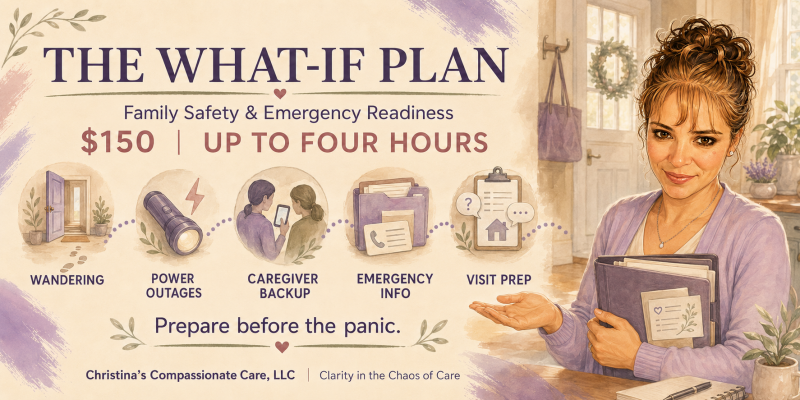
Introducing The What-If Plan
A focused Care Pathway for families who want to prepare before the panic.
$150
Up to four hours of personalized support
What if your loved one wanders away?
What if the power goes out, the primary caregiver becomes unavailable, or an unexpected fall sends everyone rushing to the hospital?
What if first responders arrive—and no one can quickly find the information they need?
No family can predict every emergency. But you can make sure important information is organized, responsibilities are understood, and everyone has a clearer idea of what to do next.
The What-If Plan is not a generic checklist. It is built around your loved one, your home, your daily routines, and the people your family can actually depend on.
The What-If Plan includes:
- A family conversation about your greatest concerns and the situations you want to prepare for
- A guided, non-medical walkthrough of the home and daily routines
- Identification of questions or concerns that should be brought to a licensed professional
- Wandering and missing-person preparation
- Severe-weather and power-outage preparation
- A backup plan for times when the primary caregiver is unavailable
- Organization of emergency contacts and important information for first responders
- A clear family communication plan, including who should be contacted and who will handle each responsibility
- Help preparing questions for occupational therapists, physical therapists, nurses, physicians, fire departments, or other appropriate professionals
- Personalized resource and referral research
- A written What-If Plan with the family’s chosen next steps
- One follow-up conversation to review the plan and address remaining questions
Preparing for a professional home visit
Sometimes a family knows something in the home is no longer working—but they do not know what kind of help they need or what questions they should ask.
Before an occupational therapist, physical therapist, nurse, or another qualified professional visits the home, I can help your family:
- Think through the routines that are becoming difficult
- Make a clear list of concerns, changes, and questions
- Gather information the professional may need
- Identify the rooms, situations, or times of day you want the professional to observe
- Prepare family members so important concerns are not forgotten during the visit
With appropriate authorization, I may also attend the visit, help take notes, and organize the professional’s recommendations into manageable next steps afterward.
Understanding my role
Christina’s Compassionate Care is a non-medical care-coordination, education, organization, and family-support service.
I am not an occupational therapist, physical therapist, nurse, home inspector, or emergency-response provider. I do not perform clinical home-safety or fall-risk evaluations, certify that a person or home is safe, or prescribe equipment or home modifications.
My role is to help your family recognize and organize its concerns, prepare meaningful questions, connect with the appropriate professionals, and follow through on the information and recommendations those professionals provide.
No plan can eliminate every risk or prevent every emergency. A thoughtful plan can help your family respond with greater clarity, confidence, and coordination when something unexpected happens.
Prepared, not scared. Let’s think through the what-ifs—together.
Start with a free conversation.

Introducing The Now What? Plan
A focused Care Pathway for families facing a change in care—and wondering what comes next.
$250
Up to seven and a half hours of personalized transition support
What if your loved one is scheduled for surgery—but no one is sure what needs to be ready before they leave home?
What if the hospital says discharge could happen tomorrow and your family already feels three steps behind?
What if home is no longer working, assisted living is being discussed, or your family is simply trying to understand the available options?
Care can change in a heartbeat—and families can go from zero to spiraling just as quickly.
The Now What? Plan helps slow everything down. Together, we’ll organize the questions, gather reliable information, clarify responsibilities, and create a manageable path through the transition.
This is not a one-size-fits-all checklist. Your support is built around the change your family is facing, the information you already have, the decisions still ahead, and the people involved.
Your seven and a half hours include:
A 90-Minute Transition Clarity Conversation
We begin by sitting down together and looking at the entire situation:
- What is changing?
- What has already been decided?
- What questions remain unanswered?
- Are there deadlines or upcoming meetings?
- Who is currently involved?
- What is causing the greatest concern?
- What needs attention first?
The goal is to slow the spiral, identify the immediate priorities, and determine how the remaining package time can best support your family.
Up to 2½ Hours of Personalized Research and Preparation
Depending on your family’s needs, this time may be used to:
- Research publicly available information about licensed care settings, community services, and local resources
- Gather facility directories, licensing information, and available public survey results
- Research transportation and community-support options
- Prepare questions for hospitals, rehabilitation centers, medical providers, facilities, insurers, or benefit programs
- Organize existing instructions, paperwork, contact information, and important documents
- Create a list of questions for legal, financial, insurance, or medical professionals
- Prepare for facility tours, care meetings, discharge conversations, or upcoming appointments
- Help family members identify their priorities and the information they still need
Up to Two Hours of Working Transition Support
This time may be used where your family needs hands-on organizational support most, including:
- Making calls together
- Scheduling tours, appointments, or family meetings
- Comparing options according to the family’s stated priorities
- Organizing information provided by hospitals, facilities, agencies, or other professionals
- Creating a family responsibility list
- Preparing for an upcoming meeting or transition date
- Attending an authorized meeting, tour, or provider conversation when permitted
- Taking notes and helping the family track questions that still need answers
Attendance at hospital, provider, or facility meetings requires appropriate written authorization and remains subject to the organization’s policies.
A One-Hour Transition Roadmap Review
Your family will receive a written Now What? Transition Roadmap that brings the information together in one place.
The roadmap may include:
- What requires attention now
- Questions that still need to be answered
- Important contacts and upcoming dates
- Options the family wants to explore
- Who is responsible for each next step
- Information to bring to upcoming meetings
- Tasks to complete before the transition
- Items requiring follow-up afterward
During our review, we’ll walk through the roadmap together so everyone understands what has been organized and what comes next.
One 30-Minute Follow-Up Conversation
After your family has had time to begin taking the next steps, we’ll reconnect to:
- Review progress
- Address remaining organizational questions
- Update the responsibility list
- Identify information that still needs to be gathered
- Determine whether additional support would be helpful
Additional follow-through may continue through Build Your Own Support at the current hourly rate.
Preparing to Leave Home
When someone is preparing for surgery, hospitalization, or a planned procedure, I can help your family organize:
- Questions for the medical team
- Existing instructions and appointment information
- Emergency contacts
- Transportation resources
- Family responsibilities
- Information that may be needed during admission
- Questions about what should be prepared at home
Medical professionals remain responsible for all clinical instructions, medication guidance, equipment recommendations, and decisions about care.
Preparing to Come Home
When a loved one is leaving a hospital or rehabilitation setting, I can help the family prepare for the hospital-led discharge process by:
- Organizing questions for the discharge meeting
- Helping track the instructions provided
- Identifying information that needs clarification from the medical team
- Researching community and non-medical support resources
- Organizing follow-up appointments and contact information
- Clarifying which family member will handle each non-medical responsibility
- Creating a practical homecoming checklist based on the professionals’ instructions
I do not create, approve, or evaluate the medical discharge plan or determine whether a discharge is clinically safe.
Preparing to Move Somewhere New
If your family is considering assisted living, memory care, skilled nursing, or another residential setting, I can help you:
- Gather publicly available options
- Review facility licensing information and available public records
- Identify the family’s priorities
- Prepare meaningful questions
- Schedule calls or tours
- Organize information provided by each facility
- Compare options using the family’s chosen criteria
- Create a moving and communication checklist
The family retains all decision-making authority. Each facility is responsible for assessing the prospective resident, determining whether it can meet that person’s needs, explaining its services and costs, and making admission decisions.
Exploring Options Without Making a Decision
Your family does not need to be in an immediate crisis to use The Now What? Plan.
Sometimes the most helpful time to begin is when everyone is asking:
- What options are available?
- What is the difference between them?
- What questions should we be asking?
- What information should we gather now?
- What might our loved one need in the future?
- Who should we speak with before making a decision?
I can help organize that exploration without pushing your family toward a particular provider, facility, or decision.
Before, During, and After Professional Conversations
Before a meeting, I can help organize the family’s concerns, information, priorities, and questions.
With appropriate authorization and permission from the organization, I may attend a meeting or tour, take notes, and help ensure the family’s prepared questions are addressed.
Afterward, I can help organize the information and recommendations provided, identify remaining questions, and add the appropriate non-medical next steps to the family’s roadmap.
Understanding My Role
Christina’s Compassionate Care provides non-medical care coordination, education, organization, resource navigation, and family support.
I am not a hospital discharge planner, nurse, therapist, social worker, attorney, financial adviser, insurance representative, or clinical placement professional.
I do not:
- Determine the appropriate level of care
- Decide where someone should live
- Select or endorse a facility as the “best” choice
- Guarantee admission, placement, coverage, or any other outcome
- Interpret or change medical instructions
- Determine insurance or benefit eligibility
- Interpret or negotiate contracts or legal documents
- Provide hands-on transfer assistance
- Provide transportation for hire
- Replace the hospital, facility, medical provider, attorney, financial professional, insurer, or other licensed professional
My role is to help your family understand the process, organize the information, prepare meaningful questions, explore available options, and follow through on the decisions your family makes.
Christina’s Compassionate Care is paid by the family receiving support. I do not accept placement commissions or referral fees from the facilities or providers discussed.
This package is not an emergency-response or on-call service. Immediate medical or safety concerns should be directed to 911 or the appropriate professional.
No service can remove every complication or guarantee that a transition will happen exactly as planned. Thoughtful preparation can help your family face the change with greater clarity, confidence, and coordination.
Care can change in a heartbeat. You do not have to figure out the next step alone.
Slow the spiral. Let’s find the next step—together.
Start with a free conversation.
At Christina's Compassionate Care, we provide clarity in the chaos of care, offering personalized
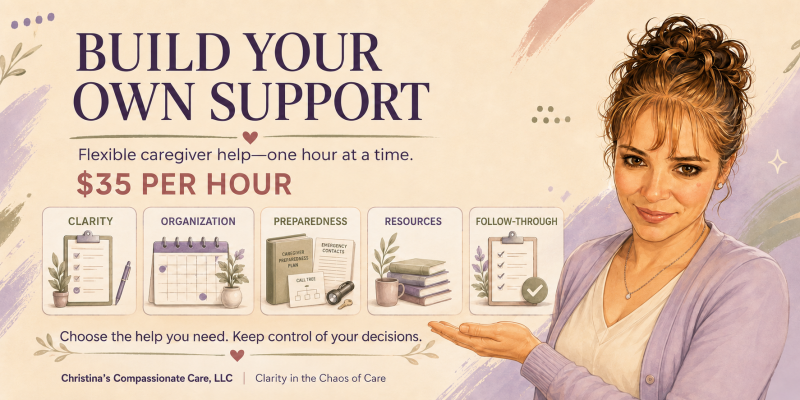
Build Your Own Support
Flexible caregiver help—one hour at a time.
$35 per hour
Sometimes you don’t need help with everything. You just need someone to take a few things off your plate.
Not every family needs a full package. You may need help making one phone call, organizing a pile of paperwork, researching a resource, preparing for an appointment, or figuring out what to do about one concern that keeps weighing on you.
Build Your Own Support allows you to choose the help you need most without purchasing a larger package. Select one area of support or combine several as your family’s needs change.
Examples of ways I can help:
- Safety planning: Work together to identify concerns involving the home, wandering, nighttime routines, emergencies, or unexpected situations.
- Phone calls and follow-up: Help prepare for or complete agreed-upon calls to agencies, facilities, providers, insurance companies, and community resources when appropriate and authorized.
- Paperwork and organization: Sort and organize caregiving information, contact lists, calendars, documents, and records so you know what you have and what may still be missing.
- Resource research: Find local programs, services, facilities, and community resources that fit your family’s situation.
- Caregiver and dementia education: Receive personalized information, tools, and practical strategies to help you feel more confident and prepared.
- Appointment preparation: Organize questions, concerns, and important information before an appointment or care-related meeting.
- Care transitions: Get organized before or after a hospital stay, rehabilitation stay, move, or change in support needs.
- Long-distance family support: Help organize agreed-upon local tasks and information when family members cannot be here in person.
- Family communication and planning: Clarify responsibilities, prepare for family conversations, and create an organized list of next steps.
- Something else: Tell me what is making caregiving harder right now, and we can discuss whether it falls within my services.
You choose. You decide. I’m here.
We will agree on the requested work before it begins. You remain in control of your family’s decisions, and additional work will never be added without discussing it with you first.
Christina’s Compassionate Care provides nonmedical coordination, education, organization, and resource support. Services do not include medical, nursing, legal, financial, insurance, or emergency services.
Choose the help you need. Keep control of your decisions.
support and resources to guide families through life's transitions.
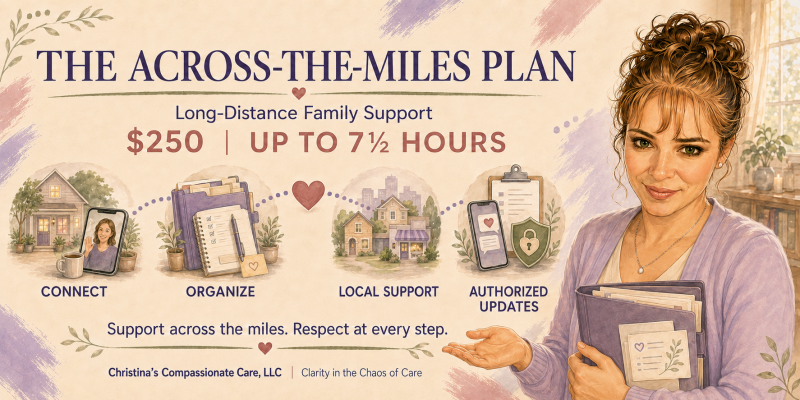
The Across-the-Miles Plan
Long-Distance Family Support
$250 | Up to 7½ Hours
Because living far away shouldn’t leave you feeling helpless.
Caring about someone from another city—or another state—can feel overwhelming. One unanswered phone call, an unexpected change, or a confusing conversation can send your thoughts spiraling.
You want to help. You want to stay informed. But you may not know whom to call, what questions to ask, or how to remain involved without overstepping your loved one’s privacy and independence.
The Across-the-Miles Plan offers compassionate, nonmedical support to help families stay connected, organized, and prepared—even when they cannot be physically present.
This package may be a good fit if:
- Your parent or loved one lives in the Green Bay area while you live farther away.
- You are struggling to understand what local services and resources are available.
- Your loved one welcomes support but needs help organizing information or completing agreed-upon tasks.
- Your family needs a clearer way to share responsibilities and communicate.
- You want help preparing questions for appointments, care meetings, or important family conversations.
- You need a trusted local professional to assist with specific, scheduled, nonmedical needs.
Together, we can:
- Identify your family’s most immediate questions and concerns.
- Create an organized list of contacts, resources, responsibilities, and next steps.
- Research local nonmedical programs and support options.
- Prepare questions for appointments or care-related meetings.
- Organize paperwork and information already available to the family.
- Coordinate agreed-upon nonmedical tasks and services.
- Develop a clear family communication plan.
- Complete scheduled, consented support visits for specific agreed-upon purposes.
- Provide factual updates only to individuals who have been properly authorized to receive them.
- Clarify what has been completed, what still needs attention, and who is responsible for each next step.
Your Across-the-Miles Support Map may include:
- Approved family contacts
- Important phone numbers and local resources
- Questions that still need answers
- Upcoming appointments or meetings
- Agreed-upon family responsibilities
- Current priorities and next steps
- A plan for communicating future changes or concerns
How the package time may be used
The package includes up to 7½ hours that may be used for planning conversations, organization, local resource research, authorized calls, scheduled and consented visits, documentation, family communication planning, and follow-up connected to the agreed scope.
This initial package is not a monthly fee and does not provide unlimited or on-call access. If continued support is needed, it may be arranged at $35 per hour through a new written agreement. No ongoing work or charges are added without approval.
Support—not surveillance
The person receiving support remains at the center of this package. Before any direct contact, visit, or information-sharing begins, Christina’s Compassionate Care must confirm who the client is, who may authorize services, and what information—if any—may be shared.
Visits, communication, and information sharing take place only with the appropriate knowledge, consent, and written authorization when required. A family member’s payment for services does not automatically create decision-making authority or permission to receive another adult’s private or medical information.
This service cannot be used to secretly monitor someone, investigate another family member, bypass a person’s wishes, or obtain information for use in a family dispute.
Important boundaries
Christina’s Compassionate Care provides nonmedical coordination, organization, education, and resource navigation.
- I do not provide medical, nursing, legal, financial, insurance, investigative, or emergency services.
- I do not make decisions for another adult, determine who has legal authority, replace a power of attorney, or interpret legal documents.
- I do not access medical records or request protected information without the authorization required by the provider or organization involved.
- Healthcare providers and other organizations determine what information they are legally permitted to share.
- I do not provide continuous monitoring, emergency response, or guarantees about another person’s health, safety, choices, or living situation.
The goal is not to take control. It is to create a respectful bridge between the person receiving support and the people who care about them—wherever they may live.
Prepared, not scared—let’s find the next step together.
Create Your Own Website With Webador